Showing posts with label disease. Show all posts

Tuesday, June 30, 2015

Sadness Causing Your Symptoms?

emotionalpain

Is Your Sadness Causing Your Symptoms?

The phenomenon of emotional health being inextricably linked to physical health has been negated by modern medicine repeatedly, with only small allowances made in integrative medicine, and extremely few studies which support this idea making their way into mainstream publications.
Nonetheless, the Pharmageddon trend plagues this country. We’re quick to admit that we are depressed, too. The makers of depression drugs are raking it in, enjoying over $14 billion in annual sales, with antipsychotics remaining the top-selling therapeutic class of prescription drugs in the US. But the sick-care industry doesn’t really look into how our emotions cause sickness in the body.
I’m not talking about the idea that stress can cause disease, either. Modern health practitioners have largely accepted this general fact, with stress having a noticeable affect on heart disease and obesity rates. More specifically, what if that argument you keep having with your husband or wife is causing your knee joints to lock up, or your constant worry over finances is causing your stomach upset or your spleen to become depleted of energy, thereby limiting your body’s immune response? What if your constantly aching shoulders are the body’s response to years of taking on more than you should – literally bearing others’ burden, or the constant itching sensation you’ve endured on your skin is because you’ve literally let someone or something ‘get under it.’

The Emotional/Astral/Mental/Physical Connection

These notions are increasingly no longer just mystical theories from ancient healers.
“The nineteen elements of the astral body are mental, emotional, and lifetronic. The nineteen components are intelligence; ego; feeling; mind (sense-consciousness); five instruments of knowledge, the subtle counterparts of the senses of sight, hearing, smell, taste, touch; five instruments of action, the mental correspondence for the executive abilities to procreate, excrete, talk, walk, and exercise manual skill; and five instruments of life force, those empowered to perform the crystallizing, assimilating, eliminating, metabolizing, and circulating functions of the body. This subtle astral encasement of nineteen elements survives the death of the physical body, which is made of sixteen gross chemical elements.” ~ Bhagavad Gita

New Scientific Proof

In modern science, they are just beginning to understand what ancient mystics and healers had detailed wisdom of. A new study published in Psychology Today examines how emotional trauma can be equally responsible for chronic pain as physical injury.
Dr. Susanne Babbel states:
Chronic pain is defined as prolonged physical pain that lasts for longer than the natural healing process should allow. This pain might stem from injuries, inflammation, or neuralgias and neuropathies (disorders of the nerves), but some people suffer in the absence of any of these conditions. Chronic pain can debilitate one’s ability to move with ease, may hinder their normal functioning, and the search for relief can lead to pain medication addictions, which compound the problem. Chronic pain is also often accompanied by feelings of hopelessness, depression, and anxiety.”

Epigenetics and Environment

Furthermore, modern medicine also fails to consider the latest discoveries of epigenetics. Often ignored is the fact that our environment (which largely shapes emotions) affects our DNA. Even with billions spent on the Human Genome Project to outline every single possible gene-controlled disease, materialist-reductionist-determinist philosophy still was no closer to understanding how perfectly good genes could turn into cancerous ones, and someone with a predisposition for cancer from several generations could overcome it simply by changing their emotional outlook.
With this new wisdom we now understand that each and every cell is like its own self-powered microprocessor. They take in signals from our subtle experience – our awe of a flower blooming, or the perfect sunset, as equally as our shame over failing a test or saying something unkind to a loved one in a flashing moment of anger.
As Bruce Lipton would explain, a cell’s receptors take in, not only the elements of the physical environment (light, gravity, temperature, salts, minerals, etc.), food (nutrients, other organisms), and life-threatening agents (toxins, parasites, predators, etc.) but also joy, fear, anger, sadness, hilarity, love, hate, etc.

The Colors of Love and Healing

In ancient yogic systems, the chakras are associated with not just emotions, but color, as certain vibratory rates reflect the emotions, which correlate to a specific place in the physical/astral body.
Root Chakra or Mooladhara – Red, the color of survival.
Second or Sacral Chakra, Swadhistana – Orange, or the cooling of red, i.e. the base ego.
Third or Solar Plexus Chakra Manipura – This is the yellow color of establishing our personal will. This is where intellect develops.
Fourth or Anahata, The Heart Chakra – The Great Equalizing force of Mother Nature. Love. This is the first chakra which represents higher development in a human (or sentient) being aside from eating, sleeping, working, and procreating.
Fifth or the Throat Chakra, Vishuddha – The color blue is expressed, or the ability to communicate our heart’s desires.
Sixth or third Eye Chakra, Anja – The indigo color of this chakra represents the Vibrational awareness that would connect us to higher levels of consciousness, otherwise known as the spiritual world.
Seventh or Crown Chakra, Sahasrara Chakra – The color Violet is indicated, as it vibrates on an entire different frequency than red. If someone’s emotions have risen to this level, they most frequently experience cosmic consciousness, and complete healing.
We can also understood the emotions as vibrations through the visible spectrum of light:
The Visible Light Spectrum
Color Wavelenght nm Frequency THz
Red 625 – 740 400 – 484
Orange 590 – 625 484 – 508
Yellow 565 – 590 508 – 526
Green 520 – 565 526 – 606
Blue 500 – 520 606 – 670
Indigo 435 – 500 670 – 700
Violet 380 – 435 700 – 789

These scientific findings also would logically explain why green spaces heal us, or we ‘see red’ and revert to our most protected, contracted, egoic self.
In the case of being surrounded in green – aside from providing a more oxygen rich environment, sitting in a park or taking a stroll among trees and flowers after a stressful day has been proven to lower blood pressure and heart rates, as well as reduce levels of cortisol. A Dutch study surveyed over 4,500 people enduring stressful life events, including the death of a loved one, serious illness, or financial hardship, and the ones who lived within 3 kilometers of green space reported higher levels of well-being and fewer health complaints in the face of their struggles than those who lived elsewhere.
Referring back to Dr. Babbel’s findings, “Often, physical pain functions to warn a person that there is still emotional work to be done, and it can also be a sign of unresolved trauma in the nervous system.”
Bingo – this is what (Ancient Chinese Medicine) ACM, and Yoga have been trying to tell us for centuries.
Here are how different pains in the body correlate to different emotions according to the study, but also corresponding to more ancient wisdom:
Pain in the Head is a sign that you are overly stressed with day-to-day occurrences. You are likely an intellectual and ‘think’ too much. Have more fun and let go of the day’s responsibilities. Your head will hurt less.
Pain in the Neck indicates that you may need to work on forgiving someone – and that person might even be you. You are likely holding unconscious stress concerning a job, your home-life responsibilities, or other ‘burdens’ that you have subconsciously agreed to bare.
Pain in the Upper Back – You are likely feeling a lack of emotional support.
Pain in Your Elbows – This kind of joint pain may mean that you are often uncompromising, and need to learn to ‘give a little’ and learn to go with the flow instead of being so rock-solid in your approach.
Pain in Your Hands – You likely need to reach out to others more, in order to fulfill your emotional needs in a healthy manner. If your ‘hands are tied’ that may also mean that you have dabbled in other people’s emotional disturbances too often and you need to allow their pain without saving them. Try being empathetic without ‘handling’ everything.
Pain in Your Hips could be a cautionary message from your body that you need to move on an important decision, and stop stalling.
Pain in Your Knees can indicate an over-inflated ego. While the ego serves the good purpose of helping us discriminate between ourselves and others when we are children, it is often in need of dissolution as we grow older.
Pain in the Ankles may indicate that you are too frugal and need to live it up a bit more. Allow yourself some pleasure, and stop running so fast from love.
Pain in the Feet may indicate that you need grounding. It also means you need more joy in your life. Try something new. Consider meeting new people, or letting your ‘feet do the walking’ instead of your fingers. Go to a concert, or an outdoor park, and take a break from your computer. The world is waiting for you.
Photo courtesy of upnaway.com

Credit and Kudos to Collective Evolution.  Always great researched articles of interest and use. Joining Collective Evolution newsletters is highly recommended.  
Full Story Source:  http://www.collective-evolution.com/2015/06/30/new-proof-that-our-emotions-cause-physical-pain-how-to-change-them/

Saturday, November 24, 2012

HYDROGEN PEROXIDE USES

28 Amazing Benefits and Uses for Hydrogen Peroxide


by Andrea Harper - docakilah.wordpress.com

Hydrogen peroxide is the only germicidal agent composed only of water and oxygen. Like ozone, it kills disease organisms by oxidation! Hydrogen peroxide is considered the worlds safest all natural effective sanitizer. It kills microorganisms by oxidizing them, which can be best described as a controlled burning process. When Hydrogen peroxide reacts with organic material it breaks down into oxygen and water.

1. Whiten Clothes – An Alternative to Beach
Add a cup of Peroxide to white clothes in your laundry to whiten them. Peroxide is great to get rid of blood stains on clothes and carpets. If there is blood on clothing, just pour directly on the spot, let it sit for about a minute, then rub and rinse with cold water. Repeat if necessary.

2. Health
Your body makes Hydrogen peroxide to fight infection which must be present for our immune system to function correctly. White blood cells are known as Leukocytes. A sub-class of Leukocytes called Neutrophils produce hydrogen peroxide as the first line of defense against toxins, parasites, bacteria, viruses and yeast.

3. Rejuvenating Detoxifying Bath
Use about 2 quarts 3% Hydrogen peroxide to a tub of warm water. Soak at least 1/2 hour, adding hot water as needed to maintain a comfortable water temperature.

4. Foot Fungus
To cure a foot fungus, simply spray a 50/50 mixture of Hydrogen peroxide and water on them (especially the toes) every night and let dry.

5. Douche
Add 2 capfuls of 3% Hydrogen peroxide in warm distilled water once to twice a week to remove even chronic yeast infections.

6. Colonic or Enema
For a colonic, add 1 cup (8 ozs.) 3% H202 to 5 gallons warm water. (Do not exceed this amount) For an enema, add 1 tablespoon of 3% H202 to a quart of warm distilled water.

7. Infections
Soak any infections or cuts in 3% for five to ten minutes several times a day. Even gangrene that would not heal with any medicine has been healed by soaking in Hydrogen peroxide. Put half a bottle of hydrogen peroxide in your bath to help rid boils, fungus or other skin infections.

8. Bird Mites Infections
Patients infected by tiny mites report that hydrogen peroxide effectively kills the mites on their skins. They spray it on their skin a couple of times (with a few minutes in between the applications) with amazing results.

9. Sinus Infections
A tablespoon of 3% Hydrogen peroxide added to 1 cup of non-chlorinated water can be used as a nasal spray. Depending on the degree of sinus involvement, one will have to adjust the amount of peroxide used.

10. Wound Care
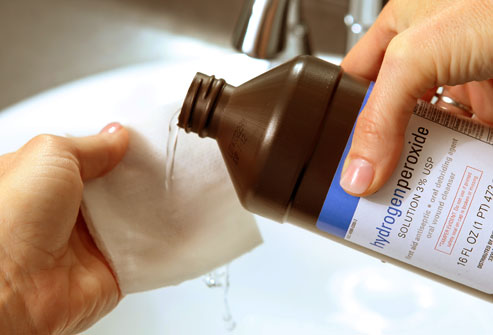
3% H2O2 is used medically for cleaning wounds, removing dead tissue, and as an oral debriding agent. Peroxide stops slow (small vessel) wound bleeding/oozing, as well.

Some sources recommend soaking infections or cuts for five to ten minutes several times a day. However, washing and rinsing action is sufficient. You shouldn’t leave the solution on open tissue for extended periods of time as, like many oxidative antiseptics, Hydrogen peroxide causes mild damage to tissue in open wounds. Therefore it is important to use with caution.

Personal Care

Mouthwash / Tooth Care
Healing Properties: Take one capful (the little white cap that comes with the bottle) and hold in your mouth for 10 minutes daily, then spit it out. You will not have canker sores and your teeth will be whiter. If you have a terrible toothache and cannot get to a dentist right away, put a capful of 3% Hydrogen peroxide into your mouth and hold it for 10 minutes several times a day. The pain will lessen greatly.

11. Mouthwash
Many people don’t realize that hydrogen peroxide makes a very effective and inexpensive mouthwash. Use 3% H202 – add a dash of liquid chlorophyll for flavoring if desired.

12. Toothpaste
Use baking soda and add enough 3% H202 to make a paste.

13. Toothbrush
Or, just dip your brush in 3% H202 and brush. Soak your toothbrush in Hydrogen peroxide to keep them free of germs.

14. Tooth Ache
Hydrogen peroxide is not a pain killer; however, as an anti-viral, antibacterial and anti-fungal agent, it is effective at treating the pathogen that is causing the infection. The following is from my own personal experience: My dentist wanted to give me a root canal some time ago as one tooth was inflamed and, in her opinion, would die. I felt some discomfort but told her that I would give it chance to heal. I rinsed with hydrogen peroxide (several times a day) as well ascoconut oil (once a day). The discomfort went away and I have had no further problems with the tooth.

15. Tooth Whitening
Having used 3% Hydrogen peroxide as a mouth wash for sometime ago, I am thrilled to note that my teeth have been beautifully and effortlessly whitened. I used to pay so much for professional whitening, those silly strips and uncomfortable trays. Live and learn.
NOTE: Do not swallow any peroxide. When the peroxide rinse is done, be sure to rinse out your mouth with water.

16. Hair Lightening
Peroxide is a bleaching agent and is used for lightened hair. Dilute 3% Hydrogen peroxide with water (50 / 50) and spray the solution on your wet hair after a shower and comb it through. You will not have the peroxide burnt blonde hair like the hair dye packages, but more natural highlights if your hair is a light brown, faddish, or dirty blonde. It also lightens gradually so it’s not a drastic change.

17. Contact Lenses
Hydrogen peroxide is used as a disinfectant in CIBA Vision’s Clear Care no rub contact lens cleaning solution, due to its ability to break down the proteins that build up on the lense from the eye’s immune response, resulting in increased comfort for those with sensitive eyes.

Sanitizing / Disinfectant / Cleaning

18. Straight or Diluted Hydrogen Perioxide
Clean your counters and table tops with hydrogen peroxide to kill germs and leave a fresh smell. Simply put a little on your dishrag when you wipe, or spray it on the counters. Use hydrogen peroxide to clean glass and mirrors with no smearing.

Keep a spray bottle of 3% (straight) to disinfect the interior of the refrigerator and kids’ school lunch boxes.

19. In the Dishwasher
Add 2 oz. of 3% Hydrogen peroxide to your regular washing formula.

Fill a spray bottle with a 50/50 mixture of 3% Hydrogen peroxide and water and keep it in every bathroom to disinfect without harming your septic system like bleach or most other disinfectants will. After rinsing off your wooden cutting board, pour or spray hydrogen peroxide (and then vinegar) on it to kill salmonella and other bacteria.

I use peroxide to clean my mirrors with, there is no smearing.
Combination of vinegar and hydrogen peroxide make a cheap, effective and non-toxic disinfectant agent and is said to be more effective at killing pathogens than bleach.  As it is non-toxic, you can use it to disinfect fruits and vegetables, as well as pet toys, equipment and cages.  In tests run at Virginia Polytechnic Institute and State University, pairing Vinegar and Hydrogen Peroxide mists, kills virtually all Salmonella, Shigella, or E. coli bacteria on heavily contaminated food and surfaces.

Directions
You need TWO spray bottles. DO NOT MIX the solutions together. Put straight vinegar in one and straight Hydrogen peroxide in the other spray bottle.

NOTE: Light destroys peroxide rather quickly. It’s best to leave it in its original bottle and screw in a spray head. DO NOT DILUTE THEM.

Remember for any sanitizer to work properly, the surface has to be clean before you use it.

When you want to sanitize a surface (vegetables, cutting board, counters, sink, cages, toys. toilets, floors, etc.), spray one (it doesn’t matter which one you use first) on the surface, then you spray on the other.  When they mix, for a brief time the chemical action of the two make a very powerful sanitizer.  You can rinse off the surface afterwards, if you want, but the result is non-toxic.

Fortunately it is cheap. BTW, we use it in the bathroom to sanitize the counters, toilets, floors, etc.

20. Mold
Clean with Hydrogen peroxide when your house becomes a biohazard after its invaded by toxic mold, such as those with water damage.

21. Humidifiers/Steamers
Use 1 pint 3% Hydrogen peroxide to 1 gallon of water.

22. Laundry / Stain Removing
Stain Remover
3% Hydrogen peroxide is the best stain lifter if used fairly soon – although blood stains as old as 2 days have been successfully lifted with Hydrogen Peroxide. Although it will bleach or discolor many fabrics. If a little peroxide is poured onto the stain it will bubble up in the area of the blood, due to a reaction with catalase. After a few minutes the excess liquid can be wiped up with a cloth or paper towel and the stain will be gone.

3% H2O2 must be applied to clothing before blood stains can be accidentally “set” with heated water. Cold water and soap are then used to remove the peroxide treated blood.

23. Washing/Laundry
You can also add a cup of hydrogen peroxide instead of bleach to a load of whites in your laundry to whiten them. If there is blood on clothing, pour directly on the soiled spot. Let it sit for a minute, then rub it and rinse with cold water. Repeat if necessary.

Peroxide is a perfect alternate solution to keep those clothes white. Also, when chlorinating clothes, they tend to wear out faster – peroxide won’t do that.

Food Preparation

24. Vegetable Soak
Use as a vegetable wash or soak to kill bacteria and neutralize chemicals. Add 1/4 cup 3% H202 to a full sink of cold water. Soak light skinned (light lettuce) 20 minutes, thicker skinned (like cucumbers) 30 minutes. Drain, dry and refrigerate. Prolongs freshness.

If time is a problem, spray vegetables (and fruits) with a solution of 3%. Let stand for a few minutes, rinse and dry.

25. Meat Sanitizing
You can also use it to rinse off your meat before cooking.

26. Leftover tossed salad
Spray with a solution of 1/2 cup water and 1 Tbsp. 5%. Drain, cover and refrigerate.

27. Marinade
Place meat, fish or poultry in a casserole (avoid using aluminium pans). Cover with a dilute solution of equal parts of water and 3% H202. Place loosely covered in refrigerator for 1/2 hour. Rinse and cook.

28. Sprouting Seeds
Add 1 ounce 3% Hydrogen peroxide to 1 pint of water and soak the seeds overnight. Add the same amount of hydrogen peroxide each time you rinse the seeds.

Grades of Hydrogen Peroxide

A) 3.5% Pharmaceutical Grade: This is the grade sold at your local drugstore or supermarket. This product is not recommended for internal use. It contains an assortment of stabilizers which shouldn’t be ingested. Various stabilizers include: acetanilide, phenol, sodium stanate and tertrasodium phosphate.

B) 6% Beautician Grade: This is used in beauty shops to color hair and is not recommended for internal use.

C) 30% Reagent Grade: This is used for various scientific experimentation and also contains stabilizers. It is also not for internal use.

D) 30% to 32% Electronic Grade: This is used to clean electronic parts and not for internal use.

E) 35% Technical Grade: This is a more concentrated product than the Reagent Grade and differs slightly in that phosphorus is added to help neutralize any chlorine from the water used to dilute it.

F) 35% Food Grade: This is used in the production of foods like cheese, eggs, and whey-containing products. It is also sprayed on the foil lining of aseptic packages containing fruit juices and milk products. THIS IS THE ONLY GRADE RECOMMENDED FOR INTERNAL USE.

G) 90%: This is used as an oxygen source for rocket fuel.
Only 35% Food Grade hydrogen peroxide is recommended for internal use. At this concentration, however, hydrogen peroxide is a very strong oxidizer and if not diluted, it can be extremely dangerous or even fatal. Any concentrations over 10% can cause neurological reactions and damage to the upper gastrointestinal tract. There have been two known fatalities in children who ingested 27% and 40% concentrations of H202. Another reports tells of a 26 month old female who swallowed one mouthful of 35% H202. She immediately began vomiting, followed by fainting and respiratory arrest. Fortunately, she was under emergency room care and although she experienced erosion and bleeding of the stomach and esophagus, she survived the incident. When she was re-examined 12 days later, the areas involved had healed (J Toxicol Clin Toxicol 90;28(1):95-100).

Personal note:  As with ANY food, drug, or supplement, using the product according to instructions is key to safety.  If someone uses too much, then of course ramifications may be felt.  We’ve NEVER heard of ANY harmful side effects from the correct usage of Food Grade hydrogen peroxide.

35% Food Grade H202 must be….
1. handled carefully (direct contact will burn the skin- immediate flushing with water is recommended).
2. diluted properly before use.
3. stored safely and properly (after making a dilution the remainder should be stored tightly sealed in the freezer).
One of the most convenient methods of dispensing 35% H202 is from a small glass eye dropper bottle. These can be purchased at your local drugstore. Fill this with the 35% H202 and store the larger container in the freezer compartment of your refrigerator until more is needed. Store the eye dropper bottle in the refrigerator. The drops are mixed with either 6 to 8 ounces of distilled water, juice, aloe vera juice or gel.
(Don’t use chlorinated tap water to dilute the peroxide!)

Article Source
Website docakilah.wordpress.com
Facebook Fanpage facebook.com/celestial.healing